Quick Answer: What Is AI for Social Media Management?
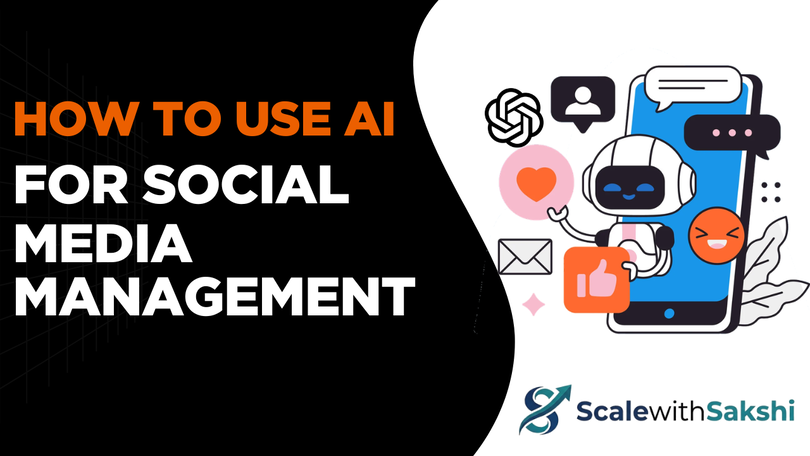
AI for social media management means using artificial intelligence tools to plan, create, schedule, publish, and analyze your social media content. These tools save time, improve content quality, and help businesses grow their online presence faster. Whether you run a small business, a startup, or a personal brand, AI can handle the repetitive parts of social media so you can focus on strategy and creativity. This guide explains exactly how to start, step by step, even if you have never used AI tools before.
Contents
- 1 Introduction: Why Social Media Management Is Harder Than It Looks
- 2 What Is AI for Social Media Management?
- 3 Why Businesses Are Switching to AI for Social Media
- 4 The 6 Core Ways AI Is Used in Social Media Management
- 5 Best AI Tools for Social Media Management in 2025
- 6 How To Use AI for Social Media Management: A Step-by-Step Process
- 7 How To Write Better AI Prompts for Social Media Content
- 8 Common Mistakes Beginners Make with AI Social Media Tools
- 9 AI for Social Media Management: Platform-Specific Tips
- 10 Does AI Remove the Human Element from Social Media?
- 11 How To Choose the Right AI Tool for Your Business
- 12 How To Measure the ROI of AI in Your Social Media Strategy
- 13 The Future of AI in Social Media Management
- 14 Conclusion: Start Small. Stay Human. Scale Smart.
- 15 Frequently Asked Questions (FAQs)
Introduction: Why Social Media Management Is Harder Than It Looks
You open Instagram. You see a brand posting every single day. The captions are sharp. The visuals are on point. The engagement is real. You wonder: how do they do this without burning out?
The answer, more often than not, is AI.
Social media management is not just about posting pretty pictures. It involves content research, writing captions, designing graphics, scheduling posts, replying to comments, tracking analytics, and planning the next week’s calendar. For one person or a small team, this is overwhelming.
That is where AI comes in. AI tools can now handle a large part of this work. They write captions, suggest hashtags, generate images, schedule posts at the best times, and even analyze what is working. The result? You get more done in less time, with better results.
This guide is for beginners. You do not need to be a tech expert. You just need to be willing to try something new.
What Is AI for Social Media Management?
AI stands for Artificial Intelligence. In simple terms, it is software that can think, learn, and make decisions — much like a human, but faster and at scale.
When applied to social media, AI tools can:
- Write captions, blog posts, and ad copy
- Design images and short videos
- Find the best time to post for maximum reach
- Schedule and auto-publish content
- Monitor comments and reply automatically
- Analyze performance and suggest improvements
- Track competitors and trending topics
Think of AI as a very smart assistant that never sleeps, never complains, and gets better the more you use it.
AI vs. Traditional Social Media Management
Traditional social media management is done manually. You write every caption. You design every graphic. You check analytics every week by hand. It takes hours. And if you miss a day, your audience notices.
AI-powered social media management automates the repetitive tasks. You still make the decisions. But the heavy lifting is done by software. This gives you more time to focus on strategy, creativity, and connecting with your audience on a human level.
Why Businesses Are Switching to AI for Social Media
The shift to AI in social media is not a trend. It is a business decision driven by real numbers.
Here is what businesses are experiencing after adopting AI tools for social media:
- Up to 60% reduction in content creation time
- Consistent posting schedules without manual effort
- Better engagement rates due to data-driven timing
- Lower cost compared to hiring a full social media team
- Faster response to trends and audience behavior
Small businesses, D2C brands, coaches, freelancers, and startups are seeing the biggest impact. They often run lean teams and cannot afford to hire five people for social media. AI levels the playing field.
According to a 2024 Hootsuite report, 80% of marketers who use AI tools say it has improved their content performance. That number is only going to grow.
The 6 Core Ways AI Is Used in Social Media Management
Let us break down the main jobs AI does in social media management today. Each one is something you can start using within days.
1. AI for Content Creation
Writing good captions is hard. Writing them every day for every platform is exhausting. AI writing tools like ChatGPT, Claude, Copy.ai, and Jasper can generate captions, hooks, CTAs, and full post copy in seconds.
You give the tool a brief — your brand tone, the product, the platform — and it writes the content. You review it, tweak it if needed, and post it. What used to take 30 minutes now takes 3.
For visual content, tools like Canva’s AI, Adobe Firefly, and Midjourney create graphics and images from text prompts. You describe what you want and the tool builds it. No design skills required.
2. AI for Content Strategy and Planning
Good social media does not happen by accident. It requires a plan. AI tools can analyze your past performance, look at what competitors are doing, and suggest content ideas that are likely to perform well.
Tools like Lately.ai and Predis.ai take your existing content — blog posts, videos, podcasts — and repurpose them into social media posts automatically. You create once. The AI distributes it everywhere.
Some tools can even build a full 30-day content calendar for you based on your brand goals, audience profile, and trending topics in your niche.
3. AI for Scheduling and Publishing
Posting at the right time matters. A great post published when your audience is asleep gets buried. AI scheduling tools like Buffer, Later, and Sprout Social analyze your audience data to find the exact time your followers are most active.
You build your content in advance. The tool publishes it at the optimal time, across multiple platforms, without you touching a button. Your Instagram, LinkedIn, Facebook, and X all stay active — even on weekends.
4. AI for Community Management
Replying to every comment and DM manually is time-consuming. AI tools can monitor your mentions, flag important comments, and even draft responses for you to approve.
Chatbot tools like ManyChat and MobileMonkey handle DMs automatically. A customer asks about your price. The bot replies instantly with the right answer. You only step in for complex conversations.
This keeps your response time fast, which improves trust and engagement — two things the algorithm rewards.
5. AI for Analytics and Reporting
Data is only useful if you understand it. AI analytics tools do not just show you the numbers. They tell you what the numbers mean and what to do next.
Platforms like Socialinsider, Metricool, and Brandwatch use AI to identify patterns in your data. Which post type drives the most clicks? Which day gets the most reach? What content makes people unfollow you?
These insights help you make smarter content decisions instead of guessing.
6. AI for Social Listening and Trend Detection
What are people saying about your brand? What topics are going viral in your niche? AI-powered social listening tools like Brand24, Mention, and Talkwalker scan millions of posts in real time and alert you to what matters.
This helps you jump on trends early, respond to negative feedback quickly, and understand your audience at a deeper level than any manual process could.
Best AI Tools for Social Media Management in 2025
There are hundreds of AI tools on the market. Here are the most reliable, beginner-friendly options across different use cases.
For Content Writing
- ChatGPT (OpenAI): Best all-around writing assistant. Free and paid plans available.
- Claude (Anthropic): Excellent for long-form, nuanced content with strong brand voice retention.
- Copy.ai: Built specifically for marketing copy and social captions. Easy for beginners.
For Visual Content
- Canva AI (Magic Write + Text to Image): Easiest for beginners. Drag-and-drop with AI built in.
- Adobe Firefly: Professional-grade image generation. Safe for commercial use.
- Predis.ai: Creates post graphics, captions, and reels from a single prompt.
- FlexClip: Best for creating AI-powered short-form videos for Reels, TikTok, and YouTube Shorts. Paste a text prompt, blog post, or script — and FlexClip builds a ready-to-post video complete with scenes, captions, voiceovers, music, and transitions. No camera or editing skills needed.
For Scheduling
- Buffer: Simple, clean interface. Great for small businesses. Free tier available.
- Later: Best for Instagram and TikTok. Features a visual calendar interface.
- Metricool: Combines scheduling with analytics. Offers a strong free plan.
For Analytics
- Sprout Social: Enterprise-level analytics. Best for growing teams.
- Metricool: Affordable all-in-one tool. Excellent for solopreneurs.
- Socialinsider: Best for competitive benchmarking and industry comparisons.
For Community Management and Chatbots
- ManyChat: Leading chatbot tool for Instagram and Facebook DM automation.
- MobileMonkey: Multi-channel chatbot for Facebook, Instagram, and SMS.
- Tidio: Great for combining live chat with AI chatbot on your website and social channels.
For Social Listening
- Brand24: Monitors brand mentions across social media, news, and blogs in real time.
- Mention: Tracks keywords and competitor activity. Beginner-friendly interface.
- Talkwalker: Enterprise social listening with deep AI-powered sentiment analysis.
How To Use AI for Social Media Management: A Step-by-Step Process
Here is a practical, beginner-friendly process you can follow starting today. No technical skills required.
Step 1: Define Your Brand Voice and Goals
Before you use any AI tool, you need to know who you are and what you want. AI is only as good as the input you give it.
Write down the following:
- Your brand personality — funny, professional, bold, warm, or a mix
- Your target audience — who are they, what do they struggle with, what do they want
- Your social media goals — brand awareness, lead generation, sales, or community building
- The platforms you want to focus on — Instagram, LinkedIn, Facebook, X, or TikTok
This becomes your AI briefing document. Every time you use an AI tool, you give it this context. The output will match your brand and not sound like a generic robot.
Step 2: Build a Content Strategy with AI
Open ChatGPT or Claude. Give it your brand brief from Step 1. Ask it to generate a 30-day content plan for your platform of choice.
Example prompt: “I run a skincare brand targeting women aged 25-40 in India. My tone is friendly and educational. Create a 30-day Instagram content calendar with post types and topic ideas.”
You will get a structured calendar in seconds. Review it. Remove anything that does not fit. Add your brand-specific campaigns. Now you have a plan.
Step 3: Create Content with AI Tools
For each post in your calendar, use AI to create the content:
- Use ChatGPT or Copy.ai to write captions
- Use Canva AI or Predis.ai to design the visuals
- Use a hashtag generator like Flick or Hashtagify to find relevant tags
- Use AI video tools like FlexClip, InVideo, or Pictory to create short-form video content from text. FlexClip is especially beginner-friendly
Always review AI-generated content before publishing. Make sure it sounds like you. Add specific details, local context, or personal examples that AI cannot know.
Step 4: Schedule and Automate Publishing
Once your content is ready, load it into a scheduling tool like Buffer, Later, or Metricool:
- Connect all your social media accounts to the scheduling tool
- Upload your posts, captions, and visuals
- Let the AI recommend the best posting times based on your audience data
- Schedule the entire month in one sitting
You have now created a month of content and scheduled it in a few hours. That is the power of AI for social media management.
Step 5: Engage with Your Audience
AI handles posting. But engagement still needs a human touch. Check your comments and DMs daily. Respond personally to meaningful conversations.
You can use AI to draft replies. But add a personal word or two before sending. People can tell the difference between a bot and a real person — and they reward authenticity.
Set up a chatbot for FAQs and common inquiries using tools like ManyChat. This keeps your response time instant even when you are busy.
Step 6: Review Analytics and Improve
At the end of each week, check your analytics. Your scheduling tool or a separate analytics tool will show you:
- Which posts got the most reach and engagement
- What time your audience is most active
- Which content type — carousel, reel, static, story — performs best
- Where your followers are dropping off
Feed these insights back into your next content plan. Ask AI to create more of what works. Stop doing what does not. This loop of create, publish, analyze, and improve is how great social media strategies are built.
How To Write Better AI Prompts for Social Media Content
The quality of AI output depends on the quality of your prompt. A vague prompt gives vague content. A specific prompt gives content you can actually use.
The BCAST Prompt Formula
Use this simple formula for every AI content prompt:
- B – Brand: Tell the AI who you are and what your brand voice is
- C – Context: Give background on the topic or campaign
- A – Audience: Describe exactly who you are talking to
- S – Style: Specify the tone, length, and format
- T – Task: Be clear about what you want — caption, thread, story, ad, etc.
Example prompt using BCAST:
“I am a social media manager for a D2C food brand. We sell healthy snacks for working professionals. My audience is urban Indians aged 25-35 who are health-conscious but time-poor. Write 3 Instagram captions for a new product launch — our protein granola bar. Tone: fun and energetic. Length: 60-80 words. Include a CTA and 5 relevant hashtags.”
That prompt gives the AI everything it needs. The output will be on-brand, relevant, and ready to use with minor edits.
Common Mistakes Beginners Make with AI Social Media Tools
AI tools are powerful, but they are easy to misuse. Here are the most common beginner mistakes and how to avoid them.
Mistake 1: Posting AI Content Without Editing
Raw AI output often sounds generic. It lacks your specific brand tone and real-world context. Always read it, adjust it, and make it yours before publishing.
Mistake 2: Using AI for Everything Without a Strategy
AI can create content all day. But without a strategy, you end up with a lot of random posts that do not build a brand. Always start with a clear content strategy before using AI to execute it.
Mistake 3: Ignoring Analytics
Many people use AI to post but never check what is working. This is like driving with your eyes closed. Review your analytics every week. Let data guide your next moves.
Mistake 4: Over-Automating Community Management
Chatbots are great for FAQs. But if every comment and DM gets a bot response, your audience will notice. Keep automation for routine queries. Show up personally for real conversations.
Mistake 5: Using Too Many Tools at Once
Beginners often sign up for 10 tools and use none of them well. Start with one AI writing tool and one scheduling tool. Master those two. Then expand.
Mistake 6: Not Training AI on Your Brand Voice
If you give AI no context about your brand, it will write in a bland, generic style. Always include your brand tone, target audience, and examples of your best-performing content in your prompts. The more context you give, the better the output.
AI for Social Media Management: Platform-Specific Tips
Different platforms need different content. Here is how AI adapts to each one.
- Use AI to write carousel scripts — educational, step-by-step content performs best
- Generate reel hooks using ChatGPT — the first 3 seconds are everything
- Use Canva AI for aesthetic story templates and branded graphics
- Use AI to write keyword-optimized captions for Instagram SEO
- Use AI to repurpose blog posts into LinkedIn thought leadership posts
- Generate professional hooks that build personal brand authority
- Use AI to draft connection request messages and outreach content
- Ask AI to create data-driven posts that perform well in the LinkedIn feed
- Use AI to write longer, story-driven posts for community groups
- Generate ad copy for Facebook and Instagram campaigns
- Use chatbot tools to manage Facebook Messenger inquiries 24/7
- Use AI to write event descriptions and Facebook Business page updates
X (formerly Twitter)
- Use AI to write tweet threads that break down complex topics
- Generate punchy, high-engagement single tweets and reply hooks
- Use AI to identify trending conversations and craft timely responses
YouTube and TikTok
- Use AI to write scripts for short-form and long-form videos
- Generate SEO-optimized video titles, descriptions, and tags
- Use tools like Pictory or InVideo to convert blog posts into video content
- Ask AI to suggest video hook ideas that stop the scroll in the first 2 seconds
Google Business Profile
- Use AI to write keyword-rich Google Business posts every week
- Generate professional responses to Google reviews — both positive and negative
- Ask AI to write Q&A content for your Google Business listing
Does AI Remove the Human Element from Social Media?
This is the number one concern people have about AI for social media. And it is a fair one.
The short answer: No. AI does not remove the human element. It removes the burden of the mechanical parts so you can double down on the human parts.
Here is what AI cannot do — and probably never will:
- Share your personal story or lived experience
- Build genuine relationships with your community
- Make judgment calls about sensitive topics
- Add the cultural nuance that resonates with a specific local audience
- Replace your expertise, opinion, or unique perspective
The brands that win with AI are the ones that use it to work faster, while staying deeply human in how they connect with their audience. AI gives you time back. Use that time to be more present, not less.
How To Choose the Right AI Tool for Your Business
With so many tools available, choosing feels overwhelming. Use this simple framework.
Ask These 5 Questions Before Buying Any AI Tool
- What specific problem does it solve? Do not buy tools for the sake of it. Know your gap first.
- Does it have a free trial? Always test before paying. Most good tools offer a free or freemium plan.
- Is it beginner-friendly? Complicated tools do not get used. Simple tools get results.
- Does it integrate with your existing platforms? Check if it works with Instagram, LinkedIn, or wherever you are active.
- What do real users say? Check G2, Capterra, or Reddit reviews before committing.
For most beginners, the ideal starting stack is: ChatGPT or Claude for writing + Canva AI for visuals + Buffer or Metricool for scheduling. That is three tools. Low cost. High impact.
How To Measure the ROI of AI in Your Social Media Strategy
Using AI is only worth it if you can see results. Here is how to measure whether your AI tools are working.
Key Metrics to Track
- Time saved: How many hours per week are you saving on content creation and scheduling?
- Content output: Are you posting more consistently than before?
- Engagement rate: Are more people liking, commenting, and sharing your content?
- Follower growth: Is your audience growing at a faster pace?
- Lead generation: Are more people clicking your link in bio, visiting your website, or contacting you?
- Cost per result: Are you spending less to get the same or better results?
Track these metrics monthly. Compare your before-AI and after-AI performance. Most businesses see measurable improvement within 60 to 90 days of consistent AI-powered social media management.
The Future of AI in Social Media Management
AI in social media is evolving fast. Here is where things are heading in the next few years.
- Hyper-personalization: AI will create different content versions for different audience segments automatically.
- Predictive content: AI will predict what content will go viral before you publish it.
- Autonomous agents: AI will run entire social media accounts with minimal human input.
- Real-time trend response: AI will detect and act on viral trends within minutes.
- Voice and video AI: AI avatars and voice cloning will let brands create video content without a camera.
- AI-powered influencer matching: Brands will use AI to find and vet the right influencer partners automatically.
The brands and marketers who learn to use AI now will have a massive advantage in the years ahead. The learning curve today is low. The competitive gap tomorrow will be enormous.
Conclusion: Start Small. Stay Human. Scale Smart.
AI for social media management is not about replacing creativity. It is about multiplying it. You bring the ideas, the strategy, and the human connection. AI handles the execution.
Start with one tool. Pick the platform where you are most active. Spend one week using AI to create content and see the difference. You will wonder why you waited so long.
The goal is not to be the brand that posts the most. It is to be the brand that shows up consistently, creates content that matters, and grows a loyal community — with less effort, more efficiency, and a strategy that actually works.
That is what AI-powered social media management gives you. And now you know exactly how to use it.
Frequently Asked Questions (FAQs)
What is the best AI tool for social media management?
There is no single best tool — it depends on your needs. For content writing, ChatGPT and Claude are top choices. For scheduling, Buffer and Later work well. For all-in-one management, Metricool or Sprout Social are strong options. Start with free plans and upgrade as your needs grow.
Can AI manage my social media accounts completely?
AI can automate a large portion of social media tasks — writing, scheduling, basic replies, and analytics. However, it cannot replace human judgment for strategy, relationship-building, and responding to complex audience interactions. The best approach combines AI automation with regular human oversight.
Is AI-generated social media content good for SEO?
Yes, when done correctly. AI can help you use keywords naturally in captions, create content around trending search topics, and optimize your bio and posts for Social SEO. The key is to edit AI output to make it original, specific, and genuinely useful to your audience — which is what both Google and AI answer engines reward.
How much does AI social media management cost?
Costs vary widely. Many AI tools have free tiers — ChatGPT free, Canva free, Buffer free for 3 channels. Paid plans typically range from $10 to $100 per month depending on the tool and features. A functional AI-powered social media setup can cost as little as $20 to $30 per month for small businesses.
Will AI make social media managers obsolete?
No. AI changes what social media managers do, not whether they are needed. Managers who learn to use AI tools will be more productive and valuable. The demand for AI-savvy social media professionals is actually increasing, as businesses want people who can combine strategic thinking with AI execution.
How do I make AI content sound more human?
Always edit AI content before publishing. Add personal anecdotes, brand-specific examples, and your natural speech patterns. Give the AI your brand voice in the prompt. Read the output out loud — if it does not sound like you, rewrite the parts that feel off. AI is a first draft, not a final one.
What is the difference between AI social media management and traditional social media management?
Traditional social media management relies entirely on manual effort — writing, designing, scheduling, and analyzing are all done by hand. AI social media management automates these tasks using software tools. The result is faster output, lower cost, more consistency, and data-driven decisions. Both require strategy and creativity, but AI significantly reduces the time and effort involved in execution.
Can small businesses in India use AI for social media?
Absolutely. In fact, small businesses benefit the most from AI tools because they often have limited budgets and small teams. Free and affordable AI tools are accessible from anywhere in India. Whether you run a local retail store, a food brand, a coaching business, or a D2C startup, AI can help you build a professional social media presence without hiring a large team.
How long does it take to set up an AI-powered social media workflow?
Most beginners can set up a basic AI workflow in one weekend. Day one: choose your tools, set up accounts, and write your brand brief. Day two: create your first month of content using AI and schedule it. From week two onward, you are in maintenance mode — reviewing analytics, refreshing content, and refining your prompts.
Is AI-generated content safe to use commercially?
Generally yes, but it depends on the tool. Most major AI writing tools — ChatGPT, Claude, Jasper, Copy.ai — allow commercial use of generated content. For AI images, always check the tool’s terms of service. Adobe Firefly, for example, is explicitly trained on licensed data and is safe for commercial use. When in doubt, always read the fine print.
About the Author
Sakshi is an AI-Powered Social Media Manager based in Chennai, India. She helps small businesses, startups, and D2C brands build high-performing social media strategies using smart AI tools. Founder of Scale with Sakshi — scalewithsakshi.com