Quick Answer (Featured Snippet)
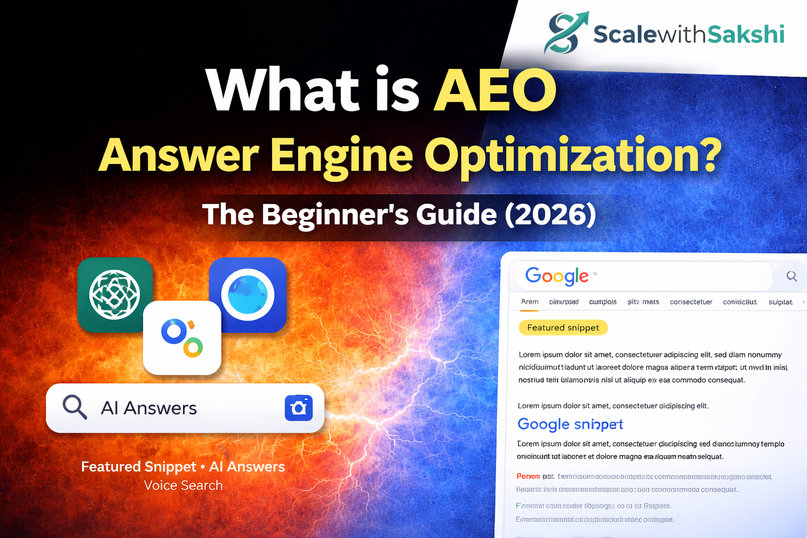
Answer Engine Optimization (AEO) is the practice of structuring your content so that AI-powered tools like ChatGPT, Perplexity, Google SGE, and voice assistants can find it, understand it, and directly quote it as an answer. Unlike traditional SEO, which focuses on getting you a ranked link, AEO focuses on getting your content selected as the actual answer. It is fast becoming one of the most important skills in digital marketing.
Contents
- 1 Introduction: The Way People Search Has Changed
- 2 What is Answer Engine Optimization (AEO)?
- 3 Why Does AEO Matter in 2026?
- 4 How Do Answer Engines Work?
- 5 Core Principles of Answer Engine Optimization
- 6 AEO for Social Media Managers: Why It Matters for Your Career
- 7 Common AEO Mistakes to Avoid
- 8 How to Do AEO: A Step-by-Step Process
- 9 AEO Tools and Resources Worth Knowing
- 10 The Future of AEO: Where This Is All Heading
- 11 Putting It All Together: AEO Is Not Optional Anymore
- 12 Frequently Asked Questions About AEO
- 12.1 What does AEO stand for?
- 12.2 How is AEO different from SEO?
- 12.3 What are examples of answer engines?
- 12.4 Do I need to do AEO if I already do SEO?
- 12.5 How do I start with AEO if I am a beginner?
- 12.6 Is AEO only for blogs and websites?
- 12.7 How long does AEO take to show results?
- 12.8 What is a featured snippet and how does it relate to AEO?
- 12.9 What is schema markup and do I need it for AEO?
- 12.10 Will AEO replace SEO?
Introduction: The Way People Search Has Changed
Think about the last time you typed a question into Google and actually clicked on a result.
Now think about how often you just read the answer Google showed you right on the page. Or asked ChatGPT. Or said, “Hey Siri, what is…”
That is the shift that has already happened. People are not just searching for links anymore. They want answers. Direct, clear, fast answers.
This change is not a trend. It is the new normal. And for anyone who creates content online, whether you are a business owner, a blogger, or an aspiring social media manager, it means one thing: you need to understand Answer Engine Optimization.
This guide explains exactly what AEO is, why it matters, how it is different from SEO, and how you can start optimizing your content for it today. No technical jargon. No fluff. Just clear, useful information.
What is Answer Engine Optimization (AEO)?
Answer Engine Optimization, or AEO, is the process of creating and structuring content so that AI systems and answer engines can pick it up and present it as a direct answer to a user’s question.
These AI systems include tools like:
- Google SGE (Search Generative Experience)
- ChatGPT and ChatGPT Search
- Perplexity AI
- Google Bard and Gemini
- Microsoft Copilot and Bing AI
- Apple Siri, Amazon Alexa, and Google Assistant
All of these tools have one thing in common. They do not just show you a list of links. They read content from across the web and synthesize an answer for you on the spot.
AEO is the practice of making sure your content is the one they pull from.
AEO vs SEO: What Is the Difference?
This is the question most people ask first. Here is a simple way to think about it.
SEO (Search Engine Optimization) helps your page show up in a list of blue links on Google. When someone searches for something, your goal with SEO is to appear on page one of those results.
AEO (Answer Engine Optimization) helps your content get selected as the actual answer. Instead of appearing as a link that someone may or may not click, your content becomes the response that the AI or search engine reads out loud or displays directly.
With SEO, success looks like a high ranking. With AEO, success looks like your words being quoted back to a user as the answer.
Both matter. But as AI takes over how people search, AEO is becoming the more important of the two.
Why Is It Called an Answer Engine?
Traditional search engines like Google show you a list of web pages. You pick one, visit it, and find your answer there.
Answer engines skip that middle step. They retrieve, process, and present the answer directly. You do not need to click anything. The AI does the reading for you.
Google SGE, for example, now generates an AI-written summary at the top of search results before showing any links. ChatGPT does the same when you ask it a factual question. Perplexity builds entire answers with citations, all without asking you to visit a single website.
The engine is not just organizing content anymore. It is answering. That is the key difference.
Why Does AEO Matter in 2026?
The numbers tell the story clearly.
Voice search queries are growing every year. Smart speakers are in millions of homes. ChatGPT crossed 100 million users within two months of launching. Perplexity is growing faster than almost any other search product in history. Google itself is rolling out AI-generated answers on the search results page through SGE.
All of this points to one reality: the way people get information is changing permanently.
Here is why that matters for your content:
Clicks Are Declining
When Google shows an AI-generated answer at the top of the page, many users never scroll down. They get what they need from that box alone. This is called a zero-click search.
Zero-click searches have been rising for years. With the expansion of AI features in search, they are rising faster than ever. That means even if you rank number one on Google, you might get fewer clicks than before.
AEO is how you win in a zero-click world. Instead of trying to get someone to click your link, you make your content the source that AI quotes. Your brand name, your ideas, and your expertise appear directly in the answer.
Voice Search Needs Direct Answers
When someone asks their phone or smart speaker a question, they receive one answer. Not ten. Not a list. One answer.
That answer has to come from somewhere. AEO is the practice of making it come from your content.
Voice search is especially important for local businesses, quick factual queries, and how-to questions. If your content is structured to answer questions clearly, it stands a much better chance of being chosen.
AI Tools Are Becoming Research Assistants
Students use ChatGPT for research. Professionals use Perplexity to find answers quickly. Business owners use Gemini to understand market trends. These AI tools pull information from content that already exists on the web.
If your content is optimized for AEO, it becomes part of the knowledge base these AI tools draw from. Your insights, your brand, and your expertise can appear in answers given to thousands of people.
If your content is not optimized, it gets ignored entirely.
E-E-A-T and Trust Matter More Than Ever
Google updated its quality guidelines to emphasize E-E-A-T: Experience, Expertise, Authoritativeness, and Trustworthiness. AI answer engines use similar signals to decide which content to trust.
Content that shows real knowledge, written by someone with genuine experience, from a trustworthy source, gets picked more often. AEO is not just about format. It is also about building the kind of credibility that AI systems recognize.
How Do Answer Engines Work?
To optimize for answer engines, it helps to understand how they work. You do not need a technical background for this. The basics are straightforward.
Step 1: Crawling and Indexing
Answer engines start by reading content from the web. Bots crawl websites, read pages, and store the information in a database. This is the same process that Google has used for decades.
The difference is what happens next.
Step 2: Understanding the Question
When you type or speak a question, the AI does not just look for matching keywords. It tries to understand the intent behind your question. What are you really asking? What kind of answer would help you most?
This is called natural language processing, or NLP. Modern AI systems are extremely good at it. They can tell the difference between “best running shoes” (you want recommendations) and “how to choose running shoes” (you want guidance), even though both queries mention running shoes.
Step 3: Finding the Best Answer
The AI then scans its index for content that best answers the question. It looks for content that is:
- Clearly written and easy to understand
- Structured in a way that makes the answer easy to extract
- Accurate and supported by trustworthy sources
- Comprehensive but concise
- Relevant to the exact question being asked
Step 4: Generating the Response
For tools like ChatGPT and Perplexity, the AI synthesizes an answer using the information it found. It may pull from multiple sources and blend the information into a single response.
For Google SGE, the AI generates a summary that appears at the top of the search results page. It often includes citations so users can visit the source if they want more detail.
Your goal with AEO is to be among those cited sources.
Core Principles of Answer Engine Optimization
Now that you understand what AEO is and why it matters, let us look at how you actually do it.
These principles apply whether you are writing a blog post, a product description, an FAQ section, or a social media caption.
1. Answer the Question Directly and Early
The most important rule of AEO is this: answer the question in the first two or three sentences of your content. Do not make the reader scroll through paragraphs of background before getting to the point.
AI systems scan for the answer. If it is buried deep in the article, they may miss it or choose a different source that answers more clearly.
A good practice is to write a short, clear answer at the top of every article or page. This serves as a featured snippet target and an AEO-friendly summary at the same time.
Example: If your article is titled “What is Content Marketing?”, your first paragraph should define content marketing in two to three clear sentences. Then you can expand on it.
2. Use Natural Question-and-Answer Formatting
People ask questions in natural language. “How do I grow my Instagram following?” “What is the best time to post on LinkedIn?” “Why does my Facebook reach keep dropping?”
Structure your content to mirror those questions. Use the question as a subheading and follow it with a direct, clear answer. This format is exactly what AI systems are trained to recognize and extract.
It also makes your content easier to read for humans, which is always a bonus.
3. Write in Simple, Clear Language
Complex sentences and industry jargon confuse AI systems just as much as they confuse human readers. Short sentences are easier to process. Simple words are easier to understand.
Write as if you are explaining something to a smart friend who is not an expert in your field. Be direct. Be clear. Use examples when something might be confusing.
The reading level of content that appears in featured snippets and AI answers tends to be lower than the average blog post. Simple language wins.
4. Use Structured Formatting
AI systems love structure. Use these formatting elements consistently:
- H2 and H3 headings that contain the exact question or keyword you want to rank for
- Short paragraphs, ideally two to four sentences each
- Bullet points and numbered lists for multi-part answers
- Tables for comparisons and data
- Definitions in bold, especially for technical or new terms
Structure helps AI systems understand your content and extract specific parts of it as answers. It also helps readers scan quickly, which reduces bounce rate and improves your overall content performance.
5. Target Long-Tail and Conversational Keywords
Traditional SEO often focuses on short, high-volume keywords like “social media marketing” or “Instagram tips.” AEO requires a different approach.
People ask AI tools full questions. They say “how do I start a social media marketing strategy for a small business” rather than just “social media strategy.” These longer, more conversational phrases are called long-tail keywords.
To optimize for AEO, build your content around the exact questions your audience asks. Use tools like Google’s “People Also Ask” section, Answer the Public, and the autocomplete suggestions in Google search to find the real questions people type.
Then answer those questions, clearly and completely, in your content.
6. Build E-E-A-T Signals
AI answer engines do not just look at how your content is written. They also look at who wrote it and why they should be trusted.
E-E-A-T stands for Experience, Expertise, Authoritativeness, and Trustworthiness. Here is how to build each one:
- Experience: Write from real experience. Share your own results, case studies, or hands-on observations.
- Expertise: Show that you know your subject deeply. Use accurate information, cite credible sources, and avoid vague statements.
- Authoritativeness: Build a reputation in your field through consistent publishing, mentions from other credible sites, and quality backlinks.
- Trustworthiness: Use a real author name, include a bio, use HTTPS, have a clear privacy policy, and keep your information updated.
Content that scores high on E-E-A-T is more likely to be selected by AI answer engines as a reliable source.
7. Optimize for Voice Search
Voice search queries tend to be longer and more conversational than typed searches. Someone typing might search “AEO definition.” The same person using voice search might say “What does AEO stand for and how does it work?”
To optimize for voice:
- Use natural, conversational language throughout your content
- Include full question phrases as subheadings
- Write in the second person where appropriate (use “you” and “your”)
- Keep your sentences short and easy to read aloud
- Answer local questions clearly if you are a local business
Voice search results often come from the top featured snippet on Google. If you can win the featured snippet, you have a strong chance of winning the voice search answer too.
8. Use Schema Markup
Schema markup is a small piece of code you add to your website that helps search engines and AI systems understand your content better.
For AEO, the most useful types of schema are:
- FAQ Schema: Marks up your frequently asked questions so Google can display them directly in search results
- HowTo Schema: Marks up step-by-step instructions
- Article Schema: Marks up blog posts and articles with author information, publication date, and more
- Speakable Schema: Specifically tells voice assistants which parts of your page are suitable for reading aloud
You do not need to be a developer to add basic schema to your site. Most WordPress plugins, including Yoast SEO and Rank Math, allow you to add schema without touching any code.
AEO for Social Media Managers: Why It Matters for Your Career
If you are an aspiring social media manager, you might be wondering how any of this applies to you. After all, social media and search seem like separate worlds.
They are not.
Here is why AEO matters for social media managers specifically:
Your Clients Need It
Small businesses and brands that hire social media managers are increasingly asking about AI search visibility. When a potential client asks “why is my competitor showing up in ChatGPT answers and I am not?”, you need to have an answer.
Understanding AEO makes you a more complete digital marketer. It gives you something valuable to offer beyond just posting schedules and caption writing.
Your Own Personal Brand Benefits From It
If you write content for your own website or blog, AEO helps that content get found. A well-optimized FAQ page on your site could show up in AI answers to questions like “what does a social media manager do?” or “how to hire a social media manager in Chennai.”
That kind of visibility is priceless for building a personal brand.
Social Content Feeds AI Systems
AI tools increasingly pull information from platforms like Reddit, LinkedIn, and even Twitter. Well-written, informative social media posts can contribute to your topical authority online.
When you post consistently on topics related to your niche, you build a body of content that AI systems may reference. This is a new and underused advantage for social media managers.
AEO Skills Are Rare and In Demand
Most social media managers focus only on platform-specific skills: Reels, carousel posts, engagement strategies. Very few also understand search, AI optimization, and content strategy.
Adding AEO to your skill set puts you in a much smaller, more valuable category of professionals. It is a real competitive advantage when pitching clients.
Common AEO Mistakes to Avoid
Knowing what not to do is just as important as knowing what to do. Here are the most common mistakes people make when trying to optimize for answer engines:
Mistake 1: Writing for Search Engines, Not People
AEO rewards content that actually helps people. Keyword stuffing, thin content, and padding articles with filler just to hit a word count will hurt you with AI systems, not help you.
Write content that genuinely answers questions. If your content is useful to a real person, it will likely be useful to an AI system too.
Mistake 2: Ignoring Question-Based Keywords
If you are only targeting short keywords and ignoring the full questions people ask, you are leaving a lot of AEO opportunity on the table.
Make a list of the top questions your target audience asks. Build content around those questions. Answer them directly. This is the core habit of AEO.
Mistake 3: No Structured Formatting
A wall of text is hard for both humans and AI to process. If your articles do not use headings, bullet points, and short paragraphs, they are much less likely to be selected as featured snippets or AI answers.
Review your existing content and add structure where it is missing.
Mistake 4: Outdated Information
AI systems and Google both prefer content that is current. If your article references information from three years ago without noting that, it may be skipped in favor of a more recent source.
Keep your content updated. Add a “Last Updated” date at the top of your articles. Review and refresh older posts regularly.
Mistake 5: Skipping the FAQ Section
FAQ sections are one of the highest-value additions you can make to any page for AEO purposes. They directly answer the questions AI systems are trying to respond to.
Every blog post, service page, and product page should have a short FAQ section at the bottom. Write it in natural question format and answer each question in three to five sentences.
How to Do AEO: A Step-by-Step Process
Here is a simple process you can follow when creating any piece of content with AEO in mind:
- Identify the core question your content answers. What is the one question someone would have to type to find this page?
- Write a two to three sentence direct answer at the top of your content. This is your featured snippet target.
- Use H2 and H3 headings that contain the questions your audience actually searches for.
- Write in short paragraphs. Keep each paragraph to two to four sentences.
- Use bullet points and numbered lists wherever you are covering multiple items.
- Add an FAQ section at the end with at least five to eight natural questions and clear answers.
- Add FAQ schema markup to the page using your SEO plugin.
- Review your content for E-E-A-T signals. Is the author identified? Are facts accurate? Is the page trustworthy?
- Update the page regularly to keep information fresh.
AEO Tools and Resources Worth Knowing
You do not need expensive tools to get started with AEO. Here are some free and affordable resources that are genuinely useful:
For Finding Questions to Answer
- Google’s People Also Ask (PAA) boxes: Free, always updated, shows exactly what people ask
- Answer the Public (answerthepublic.com): Visualizes questions and prepositions around any keyword
- Google Search Console: Shows what queries your site already appears for
- AlsoAsked.com: Builds question maps from PAA data
For Checking Featured Snippet Opportunities
- Ahrefs and SEMrush: Show which keywords trigger featured snippets and whether you rank for them
- SurferSEO: Helps structure content to match what Google currently features
For Schema Markup
- Yoast SEO (WordPress plugin): Free tier supports FAQ schema
- Rank Math (WordPress plugin): Supports multiple schema types with easy setup
- Google’s Rich Results Test: Validates your schema before you publish
For Testing Your Content in AI Tools
- ChatGPT: Ask it your target question and see if it cites or references your content
- Perplexity AI: Check whether your site appears as a cited source
- Google SGE: Use Google’s AI overview for your target keywords to see whose content is being used
The Future of AEO: Where This Is All Heading
AEO is not a trend that will fade. The direction is clear: AI-powered tools are becoming the primary way people find information. Search as we knew it in 2015 is not the same as search in 2025, and 2025 will not be the same as search in 2030.
Here are a few shifts that will shape how AEO evolves:
Multimodal Search
AI tools are getting better at understanding images, videos, and audio, not just text. In the near future, optimizing for AI answers will also mean thinking about how your images and videos can serve as sources of information.
Alt text, video transcripts, image captions, and visual content quality will all become more important for answer engine visibility.
Personalized Answers
AI answer engines are moving toward personalization. The same question asked by two different people may generate different answers based on their location, history, and preferences.
This means content that is specific, local, and contextual will become more valuable. Generic answers to generic questions will become harder to rank for.
Real-Time Information
Tools like Perplexity and ChatGPT Search are already indexing real-time content. Fresh, frequently updated content will have an even bigger advantage as these tools improve.
Brands and creators who publish consistently and keep their content current will benefit most from this shift.
Conversational Commerce
Shopping through AI assistants is already happening. In the next few years, people will be saying “buy me the best running shoes under five thousand rupees” and their AI assistant will handle the entire transaction.
For brands and e-commerce stores, AEO will directly connect to revenue. Products and services that are well-described, clearly priced, and associated with trusted reviews will win in this new world.
Putting It All Together: AEO Is Not Optional Anymore
Let us bring everything together.
Answer Engine Optimization is the practice of creating content that AI systems can find, understand, and use as answers. It is different from traditional SEO because the goal is not just to rank in a list of links. The goal is to become the answer.
The tools people use to find information are changing. ChatGPT, Perplexity, Google SGE, and voice assistants are now part of everyday life. They pull information from web content and serve it directly to users.
If your content is not structured to be found and used by these tools, it will be invisible to a growing segment of the internet.
If it is optimized, it has the potential to appear in answers seen by thousands of people, without them needing to click on your website at all.
For aspiring social media managers, content creators, and small business owners, AEO is one of the highest-value skills you can build right now. It is still early. Most content on the internet is not optimized for it. That is your advantage.
Start simple. Write clear answers. Structure your content well. Build trust. Update your information regularly. Those five habits will take you further than most.
Frequently Asked Questions About AEO
These are the questions people actually search when they want to understand Answer Engine Optimization:
What does AEO stand for?
AEO stands for Answer Engine Optimization. It is the process of structuring and writing content so that AI-powered tools and search engines can present it directly as an answer to a user’s question.
How is AEO different from SEO?
SEO aims to get your content ranked high in a list of search results. AEO aims to get your content selected as the actual answer shown to the user. With SEO, the goal is a ranked link. With AEO, the goal is your words appearing as the response, often without any click required.
What are examples of answer engines?
Examples of answer engines include ChatGPT, Perplexity AI, Google SGE (Search Generative Experience), Microsoft Copilot, Google Gemini, and voice-based tools like Google Assistant, Apple Siri, and Amazon Alexa. These tools find and present answers rather than simply listing links.
Do I need to do AEO if I already do SEO?
Yes. SEO and AEO are complementary, not interchangeable. SEO still matters for driving traffic through search results. But as AI answer tools become more common, content that is not AEO-optimized will miss an increasing share of search visibility. The two strategies work best together.
How do I start with AEO if I am a beginner?
Start by identifying the top questions your audience asks. Write short, clear answers to those questions at the top of your content. Use question-based subheadings. Add an FAQ section to every blog post. Use your SEO plugin to add FAQ schema markup. Focus on accuracy, clarity, and structure. Those steps cover most of what beginners need.
Is AEO only for blogs and websites?
AEO primarily applies to web content like blog posts, FAQ pages, service pages, and product descriptions. However, the principles of clear, question-based, structured communication also apply to social media content, especially long-form posts on LinkedIn. Strong social media content can build topical authority that indirectly supports your AEO efforts.
How long does AEO take to show results?
AEO does not have a fixed timeline. Some well-optimized pages appear in featured snippets within days of being indexed. Others take weeks or months. The best approach is to optimize every piece of content you create from day one, rather than waiting to see results and then optimizing. Consistency produces results faster than occasional optimization.
What is a featured snippet and how does it relate to AEO?
A featured snippet is the answer box that appears at the top of Google search results. It shows a short answer taken from a web page, along with the page title and link. Featured snippets are one of the primary ways AEO visibility shows up in practice. Optimizing for featured snippets is one of the core tactics of AEO. They are also the source of many Google voice search answers.
What is schema markup and do I need it for AEO?
Schema markup is code added to your website that helps search engines and AI systems understand what your content means. For AEO, FAQ schema and HowTo schema are especially useful because they signal to Google and other tools that your content is structured to answer specific questions. You do not need to code it manually. Most SEO plugins for WordPress support schema with a few clicks.
Will AEO replace SEO?
No. AEO will not replace SEO. The two will continue to evolve together. Traditional search is not disappearing, and ranked links still drive a large amount of web traffic. However, AEO will become increasingly important as AI search tools grow. Treating AEO as a layer on top of good SEO practice, rather than a replacement for it, is the most effective long-term approach.
About Scale with Sakshi
Scale with Sakshi (scalewithsakshi.com) is an AI-powered social media management brand based in Chennai, India. This blog covers social media strategy, content marketing, AEO, and digital growth tactics for aspiring social media managers and small business owners across India.