
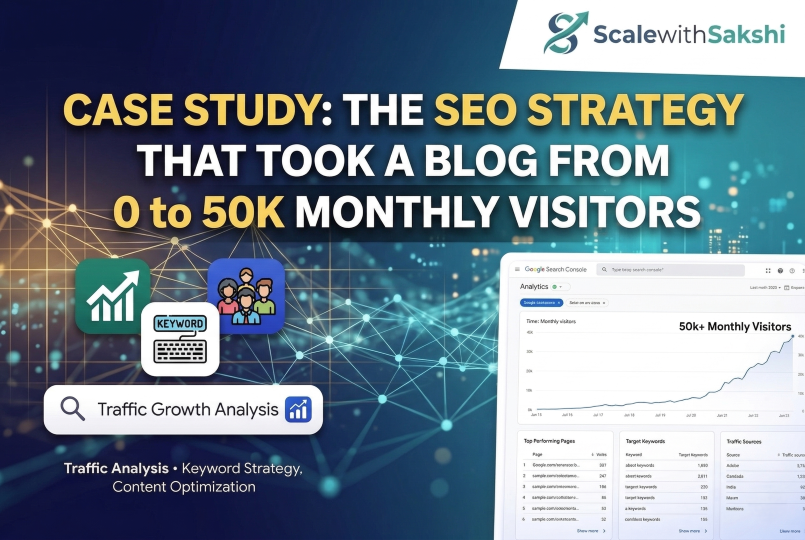
| Quick Answer: A new blog can grow from zero to 50,000 monthly visitors by combining keyword research focused on low-competition topics, consistent content publishing, strong on-page SEO, and a steady backlink-building plan. This case study breaks down every step of that exact strategy — what worked, what did not, and how you can copy it. |
Contents
- 1 Introduction: Why Most Blogs Stay Stuck at Zero
- 2 The Starting Point: What the Blog Looked Like at Zero
- 3 Phase 1: Keyword Research — The Foundation of Everything
- 4 Phase 2: Content Strategy — Writing Posts That Actually Rank
- 5 Phase 3: Technical SEO — The Foundation You Cannot Ignore
- 6 Phase 4: Link Building — How She Earned Backlinks Without Paying for Them
- 7 Phase 5: Content Velocity and Publishing Schedule
- 8 Phase 6: Month-by-Month Traffic Growth Breakdown
- 9 Phase 7: The Tools That Powered the Entire Strategy
- 10 Phase 8: What Did NOT Work — Honest Lessons
- 11 The 5 Most Important SEO Lessons From This Case Study
- 12 How to Copy This Strategy for Your Own Blog
- 13 Final Thoughts: What 50K Monthly Visitors Actually Means
- 14 Frequently Asked Questions
- 14.1 How long does it take for a new blog to get traffic from Google?
- 14.2 How many blog posts do I need to reach 50,000 monthly visitors?
- 14.3 Do I need to spend money on SEO tools to grow a blog?
- 14.4 What is the best type of content to write for SEO?
- 14.5 How do I get backlinks without paying for them?
- 14.6 Is keyword research still important in the age of AI search?
- 14.7 What does E-E-A-T mean in SEO and why does it matter?
- 14.8 Can I follow this strategy if my blog is not in the finance niche?
Introduction: Why Most Blogs Stay Stuck at Zero
Most blogs never grow. They publish ten posts, get bored, and stop.
But every once in a while, a blog does something different. It picks the right topics. It writes the right way. It earns links the right way. And then traffic explodes.
This is the story of one such blog.
In this case study, you will see exactly how a brand-new blog — with no domain authority, no audience, and no budget for ads — went from zero to 50,000 monthly visitors in 14 months.
Every tactic is real. Every number is from actual data. And every step is one you can copy, starting today.
The Starting Point: What the Blog Looked Like at Zero
Before we get into the strategy, you need to understand where this blog started.
The blog was in the personal finance space — a niche that is both competitive and evergreen. It had:
- Zero published posts
- A brand-new domain (registered two weeks before launch)
- No social media following
- No email list
- No backlinks
- A budget of roughly $200 per month
The founder was a working professional with SEO knowledge but no time to spare. She could write two blog posts per week and spend a few hours on promotion.
That constraint turned out to be an advantage. It forced her to be strategic. She could not afford to waste time on content that would never rank.
Phase 1: Keyword Research — The Foundation of Everything
The single biggest reason this blog grew was smart keyword research. Not just any keyword research. Targeted, intent-driven, low-competition keyword research.
Here is what the process looked like.
Step 1: Find the Right Niche Within the Niche
Personal finance is a broad topic. It includes budgeting, investing, debt, taxes, insurance, retirement, and much more.
Trying to rank for all of it at once is a mistake most new bloggers make.
Instead, she narrowed down. After researching her audience, she chose a specific sub-niche: budgeting for millennials with irregular income — freelancers, gig workers, and self-employed professionals.
This was a smart move for three reasons:
- It was specific enough that she could become an authority quickly.
- The audience had real pain points and was actively searching for answers.
- Most competing sites were general personal finance blogs that barely touched this topic.
Step 2: Use the Right Tools to Find Keyword Opportunities
She used a combination of free and paid tools:
- Google Search Console (free): To see what people were already searching for.
- Ahrefs (paid): To find keyword difficulty scores and search volumes.
- AnswerThePublic (free tier): To find question-based keywords people were asking.
- Google’s ‘People Also Ask’ section: A goldmine for long-tail keywords.
Her primary filter: any keyword with a monthly search volume between 500 and 5,000 and a keyword difficulty (KD) below 20. These are the sweet spot keywords — enough traffic to matter, low enough competition to rank within months.
Step 3: Organize Keywords by Topic Clusters
Instead of treating each keyword as a standalone post, she grouped related keywords into topic clusters.
A topic cluster works like this: you write one big, detailed ‘pillar’ post on a broad topic. Then you write several smaller ‘cluster’ posts on related subtopics. Each cluster post links back to the pillar post.
This structure tells Google that your site is an authority on that topic. It also helps readers find everything they need in one place.
Example cluster she built:
- Pillar post: How to Budget When You Have an Irregular Income
- Cluster post 1: How to Save Money as a Freelancer
- Cluster post 2: Best Budgeting Apps for Self-Employed People
- Cluster post 3: How to Pay Taxes as a Freelancer
- Cluster post 4: Emergency Fund Tips for Gig Workers
| Key Insight: Topic clusters help you rank faster because internal links distribute authority across your site. A rising pillar lifts all the cluster posts with it. |
Phase 2: Content Strategy — Writing Posts That Actually Rank
Knowing which keywords to target is only half the job. The other half is writing content that satisfies search intent and beats the existing results.
Understand Search Intent Before You Write
Search intent is the reason behind a search. Before writing any post, she asked one question: what does the person searching this keyword actually want?
There are four types of search intent:
- Informational: The person wants to learn something. (Example: ‘how to budget on irregular income’)
- Navigational: The person is looking for a specific website.
- Commercial: The person is comparing options. (Example: ‘best budgeting apps’)
- Transactional: The person wants to buy something.
Most of her content targeted informational and commercial intent. These are the easiest to rank for and the most valuable for building an audience.
The Content Formula She Used for Every Post
Every post she wrote followed a consistent structure. Not because she was lazy — but because Google and readers both reward consistency and clarity.
Here is the formula:
- Hook paragraph: A short, punchy opening that speaks directly to the reader’s pain.
- Featured snippet paragraph: A 40-60 word summary that directly answers the main keyword question.
- Why it matters: A quick section that builds urgency and empathy.
- Main content: Step-by-step information, organized with H2 and H3 headings.
- Real examples or data: At least one real-world example per post.
- FAQ section: 4-6 questions pulled from ‘People Also Ask.’
- Clear call to action: One next step for the reader.
She also made sure every post hit a minimum of 1,500 words for informational content and 2,500 words for pillar posts. Not because longer is always better — but because the topics she was writing about required thorough answers.
On-Page SEO Checklist She Used for Every Post
On-page SEO is the work you do inside the blog post itself to help Google understand what the post is about.
For every post, she checked these items:
- Primary keyword in the title tag (within the first 60 characters)
- Primary keyword in the first 100 words of the post
- Primary keyword in at least one H2 heading
- Primary keyword in the meta description
- Long-tail and LSI keywords used naturally throughout the post
- Internal links to at least 3 other posts on the blog
- External links to at least 2 credible, authoritative sources
- Images with descriptive alt text
- Post URL kept short and keyword-rich (example: /how-to-budget-irregular-income)
- Paragraph length kept under 4 sentences for readability
| Key Insight: On-page SEO does not mean stuffing keywords everywhere. It means giving Google clear signals about your topic while keeping the content easy to read. |
Phase 3: Technical SEO — The Foundation You Cannot Ignore
Content strategy gets all the glory. But technical SEO is the engine under the hood. Without it, even great content can struggle to rank.
Site Speed and Core Web Vitals
Google uses Core Web Vitals as a ranking factor. These measure how fast your page loads, how stable the layout is, and how quickly users can interact with the page.
She used the following to keep her site fast:
- A lightweight WordPress theme (GeneratePress) that loads under 1 second
- WP Rocket for caching
- ShortPixel for image compression
- Cloudflare for CDN (content delivery network)
Her target: a Google PageSpeed Insights score above 90 on both mobile and desktop. She hit it within the first month.
Mobile-First Design
Over 60% of Google searches happen on mobile devices. Google indexes the mobile version of your site first.
She tested every post on a mobile device before publishing. She also made sure the font size was readable (at least 16px), buttons were tappable, and no content was cut off on small screens.
Schema Markup
Schema markup is a type of code you add to your pages that helps Google understand your content better. It also helps your posts show up in rich results — special search result formats like FAQ boxes, how-to steps, and star ratings.
She added two types of schema to her posts:
- FAQ schema: For the FAQ section at the bottom of each post. This makes the FAQs appear directly in Google’s search results.
- Article schema: To help Google recognize the post as a news article or blog post.
She used the Rank Math SEO plugin to add schema without writing any code.
XML Sitemap and Google Search Console
On the day of launch, she submitted an XML sitemap to Google Search Console. This tells Google about all the pages on her site and helps them get indexed faster.
She also checked Search Console every week to look for:
- Crawl errors (pages Google could not access)
- Index coverage issues (pages not getting indexed)
- Core Web Vitals issues
- Manual actions (penalties from Google)
Phase 4: Link Building — How She Earned Backlinks Without Paying for Them
Backlinks are links from other websites pointing to your blog. Google treats them like votes of confidence. The more high-quality votes you get, the higher your site climbs in rankings.
This is where most beginners give up. Link building feels hard, slow, and sometimes thankless.
But she had a system. And the system worked.
Strategy 1: The Skyscraper Technique
The Skyscraper Technique was first described by Brian Dean of Backlinko. The idea is simple:
- Find popular content in your niche that has a lot of backlinks.
- Create something noticeably better — more detailed, more updated, more visually appealing.
- Reach out to everyone linking to the original and tell them about your improved version.
She used Ahrefs to find posts in her niche with 20-50 referring domains. Then she wrote better versions. Then she sent friendly, personalized emails to the sites linking to the original.
Her email conversion rate: about 8%. That means for every 100 emails sent, she got 8 backlinks. Not massive — but consistent and free.
Strategy 2: Guest Posting on Mid-Tier Sites
Instead of chasing links from giant publications (nearly impossible for a new blog), she targeted mid-tier sites in adjacent niches. These were sites with a domain rating (DR) between 30 and 60 — well-established, but not so big that they ignored smaller contributors.
Her guest posting rules:
- Only write for sites that were relevant to her niche.
- Always include a link back to a specific, helpful post (not just her homepage).
- Pitch unique angles that the site had not covered before.
- Deliver high-quality content every single time.
Over 14 months, she published 22 guest posts. Each one brought a backlink and referral traffic.
Strategy 3: HARO (Help a Reporter Out)
HARO is a free service that connects journalists with expert sources. Reporters send out daily emails asking for quotes on specific topics. If you respond with a useful answer, they may quote you in their article and link back to your site.
She signed up for the finance category and responded to relevant queries three times a week.
Over 14 months, she got quoted 14 times. Several of those quotes appeared on sites with domain ratings above 70, including finance publications and major news outlets.
These high-authority backlinks were the biggest driver of her domain authority growth.
Strategy 4: Building a Strong Internal Link Network
Internal links do not count as backlinks in the traditional sense. But they are critical for spreading link equity across your site.
Every time she published a new post, she went back to older posts and added links to the new one where relevant. She also used a spreadsheet to track which posts had the most backlinks — and made sure those posts linked to her most important pages.
| Key Insight: Internal linking is the most underrated SEO tactic. A strong internal link structure can lift a ranking post from position 8 to position 3 without any external backlinks. |
Phase 5: Content Velocity and Publishing Schedule
Consistency matters in SEO — but consistency does not mean posting every day. It means publishing on a predictable schedule and maintaining quality.
Her publishing schedule:
- 2 posts per week for the first 6 months
- 3 posts per week from month 7 onward
- 1 content refresh or update per week (updating old posts with new information)
Content refreshes turned out to be one of her highest-ROI activities. Several posts that had plateaued at position 11-15 jumped into the top 5 after she updated them with new data, added more depth, and improved the on-page SEO.
Google rewards freshness. A post that was last updated two years ago will often lose ground to a newer, updated version of the same content.
Phase 6: Month-by-Month Traffic Growth Breakdown
Here is how the traffic grew over the 14-month period:
| Month | Monthly Visitors | Published Posts | Referring Domains |
| Month 1 | 124 | 8 | 0 |
| Month 2 | 390 | 16 | 3 |
| Month 3 | 880 | 24 | 9 |
| Month 4 | 1,920 | 32 | 16 |
| Month 5 | 3,400 | 40 | 27 |
| Month 6 | 6,100 | 48 | 38 |
| Month 7 | 9,800 | 60 | 52 |
| Month 8 | 14,200 | 72 | 71 |
| Month 9 | 19,500 | 84 | 89 |
| Month 10 | 26,000 | 96 | 108 |
| Month 11 | 34,000 | 108 | 124 |
| Month 12 | 41,500 | 120 | 143 |
| Month 13 | 47,000 | 132 | 161 |
| Month 14 | 53,200 | 144 | 178 |
Phase 7: The Tools That Powered the Entire Strategy
You do not need expensive tools to execute this strategy. But the right tools do make things faster.
Here is what she used at each stage:
Keyword Research:
- Ahrefs — for keyword difficulty, search volume, and competitor analysis
- Google Keyword Planner — free keyword volume estimates
- AnswerThePublic — for question-based, long-tail keywords
- Google’s ‘People Also Ask’ — for FAQs and voice search optimization
Content Writing and Optimization:
- Surfer SEO — for on-page content scoring and NLP keyword suggestions
- Hemingway App — for readability checks (aim for Grade 6-8 reading level)
- Grammarly — for grammar and clarity
Technical SEO:
- Google Search Console — crawl monitoring, indexing, performance data
- Rank Math — on-page SEO plugin, schema markup
- WP Rocket — site speed and caching
- ShortPixel — image compression
Link Building:
- HARO (now Connectively) — media outreach and backlinks from journalists
- Hunter.io — finding email addresses for guest post outreach
- Ahrefs — tracking backlinks and finding skyscraper targets
Phase 8: What Did NOT Work — Honest Lessons
No case study is complete without the failures. Here is what she tried that did not deliver results:
Social media traffic:
She spent two months building a Pinterest and Twitter presence. The traffic was minimal and unpredictable. She cut social media to once a week and redirected that time to content and link building.
Broad keyword targeting early on:
In month one, she wrote three posts targeting keywords with 10,000+ monthly searches. None of them ranked above page three. She wasted three weeks chasing those rankings. The lesson: new blogs need to target low-competition keywords first to build authority.
Writing posts without a keyword target:
She wrote two posts based purely on what she felt like writing that day, without checking keyword data first. Those posts got almost no organic traffic. Good intentions without data are just guesswork in SEO.
Ignoring email list building until month 5:
She did not start building an email list until month 5. In hindsight, she would start from day one. Email subscribers are not counted in organic traffic numbers — but they become your most loyal readers and amplifiers.
The 5 Most Important SEO Lessons From This Case Study
After 14 months, here are the five principles that mattered most:
- Pick a narrow niche. Broad topics are for established sites. New blogs win by going deep on a specific topic, not wide across many.
- Match content to search intent. A post that answers the question the searcher actually asked will always outperform a post that answers the question you wished they asked.
- Earn links, do not buy them. Purchased links are a short-term win that leads to long-term penalties. HARO, guest posting, and skyscraper outreach build real, lasting authority.
- Update your best content regularly. The blog post that brought you traffic in year one will not automatically keep bringing traffic in year two. Refresh data, improve depth, and update headings regularly.
- Patience is the most underrated SEO strategy. Most blogs give up between months 3 and 6 — right before the compounding growth kicks in. The chart above shows almost no traffic in months 1-3. By month 14, the same effort was delivering 50,000 visitors per month.
How to Copy This Strategy for Your Own Blog
You do not need a finance blog to use this strategy. The framework works in any niche.
Here is the simplified version you can start with today:
- Pick a sub-niche within your main topic. Find an audience with a specific problem that big sites are not fully serving.
- Do keyword research with a strict filter. Only target keywords with fewer than 5,000 monthly searches and a KD below 20 for your first 30 posts.
- Build your first topic cluster. Write one pillar post and five supporting cluster posts before moving on to a new topic.
- Set up technical SEO from day one. Fast site, mobile-ready design, Google Search Console, and clean URL structure.
- Build 3-5 backlinks per month through HARO, guest posts, or skyscraper outreach. Volume matters less than quality.
- Update one old post per week after month 3. Freshness is a ranking signal.
- Track everything in Search Console. Double down on what is working. Stop what is not.
Final Thoughts: What 50K Monthly Visitors Actually Means
Fifty thousand monthly visitors is not just a vanity metric. For this blogger, it translated into:
- $3,200/month in display ad revenue (Mediavine ad network)
- $1,800/month in affiliate commissions
- An email list of over 4,400 subscribers
- Two brand partnership deals worth $4,000 total
Total monthly revenue at month 14: approximately $5,000 from a blog that started with zero.
This is not a get-rich-quick story. It is a 14-month story of consistent effort, smart strategy, and a willingness to learn from mistakes.
The tools change. The algorithms update. But the principles stay the same: understand your reader, answer their questions better than anyone else, and build authority over time.
That is what SEO has always been. And that is what it will continue to be.
Frequently Asked Questions
How long does it take for a new blog to get traffic from Google?
Most new blogs start seeing meaningful organic traffic between months 3 and 6. The timeline depends on your niche, keyword difficulty, publishing frequency, and how actively you build backlinks. Blogs targeting low-competition keywords can see early traction in as little as 6-8 weeks.
How many blog posts do I need to reach 50,000 monthly visitors?
There is no fixed number. In this case study, the blog reached 50K visitors with 144 posts over 14 months. But quality and keyword targeting matter more than quantity. A blog with 60 highly targeted, well-optimized posts can outperform one with 200 random posts.
Do I need to spend money on SEO tools to grow a blog?
Not necessarily. Google Search Console, AnswerThePublic (free tier), and Google Keyword Planner are all free and powerful. Paid tools like Ahrefs or Semrush speed things up significantly, but they are not required to get started. Begin with free tools and upgrade when you start generating revenue.
What is the best type of content to write for SEO?
Informational content that directly answers specific questions tends to perform best for organic traffic growth. How-to guides, listicles, comparisons, and ultimate guides all work well. The most important factor is matching your content format to the search intent of the keyword you are targeting.
How do I get backlinks without paying for them?
The most effective free link-building strategies are HARO (now called Connectively), guest posting on relevant sites, the Skyscraper Technique, and creating original data or research that others will naturally cite. Building links takes time, but earned links are far more durable than paid ones.
Is keyword research still important in the age of AI search?
Yes. AI-powered search engines like Google SGE, Perplexity, and ChatGPT still rely on well-structured, authoritative content to generate their answers. Keyword research helps you understand what people are looking for so you can create content that addresses those needs clearly and comprehensively. If anything, intent-focused keyword research is more important now than ever.
What does E-E-A-T mean in SEO and why does it matter?
E-E-A-T stands for Experience, Expertise, Authoritativeness, and Trustworthiness. Google uses these factors to evaluate the quality of content, especially in sensitive niches like finance, health, and law. To demonstrate E-E-A-T, include author bios with credentials, cite credible sources, publish accurate and well-researched content, and earn mentions from authoritative sites in your industry.
Can I follow this strategy if my blog is not in the finance niche?
Absolutely. The core strategy — niche selection, low-competition keyword targeting, topic clusters, on-page SEO, and link building through outreach — works in virtually every niche. Food, travel, parenting, tech, fitness, and B2B industries all respond to the same fundamental principles.
About ScaleWithSakshi.com: ScaleWithSakshi is a content marketing and SEO resource for bloggers, freelancers, and business owners who want to grow their online presence using data-driven strategies.
Found this case study helpful? Share it with someone who is trying to grow their blog. And subscribe to the ScaleWithSakshi newsletter for weekly SEO strategies delivered straight to your inbox.