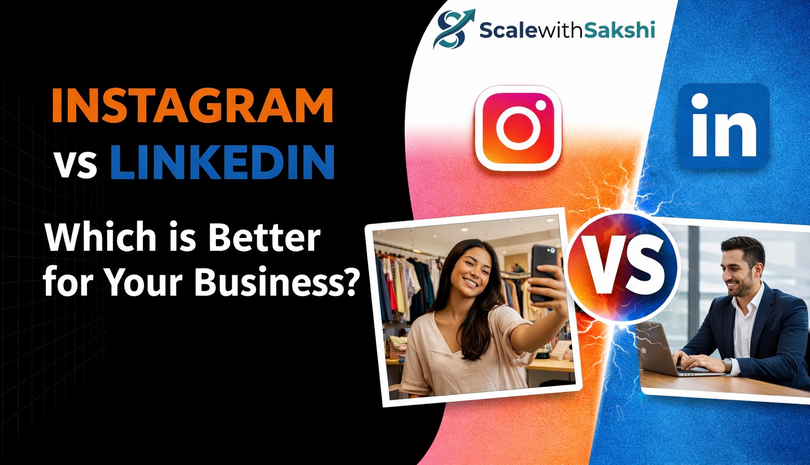
Quick Answer: Instagram vs. LinkedIn — Which Is Right for Your Business?
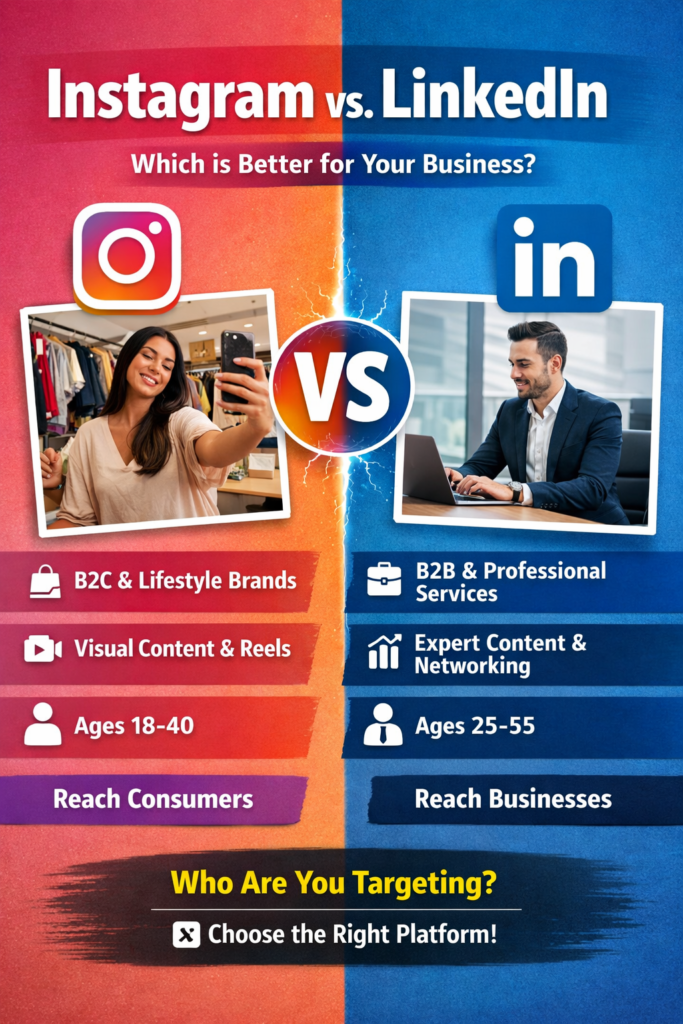
Instagram is best for visual brands, B2C businesses, lifestyle products, and audiences aged 18 to 40. LinkedIn is best for B2B companies, professional services, personal branding, and reaching decision-makers. In 2026, choosing between them depends on who you are selling to, what you are selling, and where your buyers actually spend their time. Many businesses need both — but for different goals and different types of content.
Contents
- 1 The Question Every Business Owner Asks
- 2 Understanding the Two Platforms
- 3 Instagram vs. LinkedIn: The Key Differences
- 4 Who Should Be on Instagram?
- 5 What Kind of Content Works on Instagram in 2026?
- 6 Who Should Be on LinkedIn?
- 7 What Kind of Content Works on LinkedIn in 2026?
- 8 Instagram vs. LinkedIn: Which One Wins for Your Business Type?
- 9 Organic Reach: Where Can You Grow Without Paying?
- 10 Paid Advertising: Instagram Ads vs. LinkedIn Ads
- 11 Can You Use the Same Content on Both Platforms?
- 12 Instagram vs. LinkedIn for Indian Businesses Specifically
- 13 How to Decide: A Simple Framework
- 14 The Final Verdict: Instagram or LinkedIn?
- 15 Frequently Asked Questions (FAQs)
- 15.1 1. Is Instagram or LinkedIn better for small businesses?
- 15.2 2. Can a business be on both Instagram and LinkedIn at the same time?
- 15.3 3. Which platform has better organic reach in 2026 — Instagram or LinkedIn?
- 15.4 4. Is LinkedIn good for local businesses?
- 15.5 5. Which platform is better for personal branding?
- 15.6 6. How often should I post on Instagram vs. LinkedIn?
- 15.7 7. Are LinkedIn ads worth it for small businesses?
- 15.8 8. Which platform is growing faster in India — Instagram or LinkedIn?
- 15.9 9. What type of content gets the most engagement on LinkedIn in 2026?
- 15.10 10. I am a social media manager — should I be on Instagram or LinkedIn?
The Question Every Business Owner Asks
You have a business. You know you need to be on social media. You have limited time, limited budget, and a whole list of other things to do.
So the question hits: Instagram vs. LinkedIn?
Both platforms are massive. Instagram has over 2 billion monthly active users worldwide. LinkedIn has over 1 billion members across 200 countries. Both offer ways to reach customers, build a brand, and drive sales.
But they are fundamentally different tools. Using the wrong one is like showing up to a job interview in a swimsuit. Technically you showed up. But the context is all wrong.
This guide will help you figure out which platform is the right fit for your business — and in some cases, how to use both without burning out.
Understanding the Two Platforms
What Is Instagram?
Instagram is a visual-first social media platform owned by Meta. It launched in 2010 and has grown into one of the most-used platforms in the world.
On Instagram, content lives in several formats: feed posts (photos and carousels), Stories (24-hour content), Reels (short videos), and Lives. The platform is built around discovery — the algorithm actively pushes your content to people who do not follow you yet.
Instagram is where people go to be inspired, entertained, and influenced. It is highly visual, highly emotional, and heavily driven by aesthetics.
The core audience on Instagram leans younger — ages 18 to 34 make up the largest segment globally. But usage has expanded significantly into the 35 to 50 age range, especially in urban India and Southeast Asia.
What Is LinkedIn?
LinkedIn is a professional networking platform owned by Microsoft. It launched in 2003 and has become the default platform for career growth, B2B marketing, and professional thought leadership.
On LinkedIn, content formats include text posts, articles, newsletters, polls, short videos, and carousels (called documents). The feed rewards expertise and professional insight. People come to LinkedIn to learn, hire, get hired, close deals, and build professional credibility.
The core audience on LinkedIn is professionals — managers, founders, executives, marketers, HR professionals, and decision-makers. The average LinkedIn user is 25 to 55 years old, college-educated, and in a professional role.
In India, LinkedIn has seen explosive growth. It crossed 130 million Indian members in 2024, making India one of its largest markets globally.
Instagram vs. LinkedIn: The Key Differences
| Factor | ||
| Primary Use | Discovery, entertainment, inspiration | Professional networking, B2B, credibility |
| Content Style | Visual, emotional, aesthetic | Informative, professional, text-heavy |
| Audience Age | 18 to 40 (core) | 25 to 55 (core) |
| Best For | B2C, lifestyle, e-commerce, D2C | B2B, SaaS, services, personal brand |
| Content Formats | Reels, Stories, carousels, posts | Posts, articles, newsletters, polls, video |
| Algorithm | Discovery-driven (reaches non-followers) | Network + engagement driven |
| Tone | Casual, visual, personality-led | Professional, insightful, value-driven |
| Organic Reach | Strong for Reels and new accounts | Strong for text posts and thought leadership |
| Paid Ads | Excellent for B2C, visual products | Expensive but precise for B2B targeting |
| Lead Generation | Indirect (brand to sale) | Direct (relationship to deal) |
| India Usage | 500M+ users, massive | 130M+ members, rapidly growing |
Who Should Be on Instagram?
Instagram is the right platform for your business if your product or service has a strong visual dimension and your target customer is a consumer, not a corporate buyer.
B2C and D2C Brands
If you sell directly to individual customers — clothing, skincare, food, home decor, jewellery, fitness products — Instagram is your primary battleground.
Instagram’s visual feed is a product discovery engine. People browse, save, and click through to buy. The platform has built-in shopping features in many countries, and even where it has not launched fully, users move from Instagram to a website to purchase.
Brands like Nykaa, Mamaearth, and Sugar Cosmetics built massive awareness on Instagram before they became household names. Their strategy? Consistent visual storytelling, influencer partnerships, and community engagement.
Lifestyle and Creative Businesses
Photographers, interior designers, fashion stylists, bakers, cafes, fitness trainers, travel brands — all of these thrive on Instagram.
The platform rewards beauty. If your work looks good in a photo or a 30-second video, Instagram will amplify it.
Local Businesses Targeting Consumers
A salon in Chennai. A bakery in Pune. A yoga studio in Bangalore. These businesses need Instagram.
Why? Because their customers are on Instagram. Young urban Indians use Instagram to discover local restaurants, salons, boutiques, and services. A strong Instagram presence with location tags, local hashtags, and great visuals drives real-world footfall.
Personal Brands Targeting a Consumer Audience
If you are a content creator, fitness influencer, travel blogger, or lifestyle coach whose audience is the general public — Instagram is your home.
Instagram gives personal brands unmatched reach through Reels and Stories. A single well-made Reel can reach hundreds of thousands of people who have never heard of you before.
Brands Targeting 18 to 35 Year Olds
If your primary buyer is under 35, Instagram is non-negotiable. This age group uses Instagram daily. They discover brands there, follow businesses they like, and make buying decisions based on what they see on their feed.
What Kind of Content Works on Instagram in 2026?
Instagram’s algorithm in 2026 heavily favours Reels over any other content format. Short-form video gets significantly more organic reach than static posts.
Reels
Reels are 15 to 90-second videos that get pushed to non-followers through the Explore page and the Reels tab. A well-made Reel can go from 0 to 50,000 views in 48 hours with zero paid promotion.
For businesses, Reels should be educational, entertaining, or both. Show how your product works. Tell a quick story. Share a before and after. React to a trending audio. The key is to hook the viewer in the first 2 seconds.
Carousels
Carousel posts — multiple images or slides in one post — drive the highest saves and shares of any static format. Educational carousels that teach something specific perform especially well.
For example, a social media manager might post: ‘5 Instagram mistakes that are killing your reach’ as a 6-slide carousel. Each slide is one point. The last slide is a call to action.
Stories
Stories disappear after 24 hours and are seen mainly by your existing followers. They are best for behind-the-scenes content, polls, quick updates, and building intimacy with your current audience.
Stories do not grow your reach. But they deepen loyalty with people who already follow you.
Feed Posts
Standard single-image posts have lower reach than Reels and carousels. But they still matter for brand aesthetics and first impressions. When someone visits your profile, they see your feed. Make it look intentional.
What Instagram Rewards
- Consistent posting — at least 3 to 5 times per week
- Reels that get watched all the way through
- Posts that get saved and shared, not just liked
- Quick replies to comments within the first hour of posting
- Using all features — Reels, Stories, carousels, and Lives
Who Should Be on LinkedIn?
LinkedIn is the right platform if your buyers are professionals, businesses, or decision-makers. It is also the most powerful platform for building a personal brand in the professional world.
B2B Companies
If your business sells to other businesses — software, consulting, legal services, HR solutions, marketing services, financial products — LinkedIn is where your buyers live.
A CEO looking for a new CRM. A marketing head scouting for an agency. An HR director evaluating training platforms. They are all on LinkedIn, and they are actively reading content there.
LinkedIn is the only major social platform where you can reach decision-makers directly and organically. You can connect, send a message, post a case study, and close a deal — all within the same platform.
Founders and Entrepreneurs
LinkedIn has become the platform of choice for startup founders and business owners who want to build credibility, attract investors, hire talent, and share their journey.
A founder sharing weekly lessons from building their company will attract customers, partners, press coverage, and potential hires. That is a return no paid ad can replicate.
Professional Service Providers
Lawyers, accountants, consultants, coaches, recruiters, financial advisors — professionals whose clients need to trust them deeply before hiring them.
LinkedIn lets you demonstrate expertise through written content. A tax consultant who posts weekly about common filing mistakes builds trust with exactly the kind of person who would hire them.
Personal Brands in Professional Niches
If your expertise is in marketing, technology, finance, HR, leadership, education, or any professional field — LinkedIn gives you direct access to your most relevant audience.
Social media managers, digital marketers, and marketing consultants — like many of Scale with Sakshi’s clients — often find that LinkedIn generates more qualified leads per post than Instagram, even with fewer followers.
Recruiters and Hiring Teams
If talent acquisition is part of your growth strategy, LinkedIn is essential. It is the largest professional talent database in the world. Whether you are hiring or being hired, your LinkedIn presence directly affects your opportunities.
What Kind of Content Works on LinkedIn in 2026?
LinkedIn in 2026 rewards expertise, authenticity, and conversation. The algorithm favours content that generates meaningful comments over passive likes.
Text Posts with a Strong Opening Line
LinkedIn is still primarily a text-first platform. A well-written post that starts with a striking observation, a surprising fact, or a relatable problem can get thousands of views with no images or videos attached.
The first line is everything on LinkedIn. If it does not make someone stop scrolling, nothing else matters. Strong first lines challenge assumptions, share a counterintuitive insight, or open a story mid-action.
Personal Story Posts
Posts that share real professional experiences — failures, turning points, lessons learned — consistently outperform generic tips and advice.
People do not connect with perfect. They connect with real. A post about a deal that fell apart and what you learned from it will get more engagement than a post listing ‘7 sales tips.’
Document Carousels
LinkedIn carousels — uploaded as PDF documents — are the highest-performing visual format on the platform. They work similarly to Instagram carousels: each slide builds on the last, and the reader swipes through to get value.
Topics that perform well: frameworks, step-by-step guides, industry data breakdowns, before-and-after transformations, and case study summaries.
Short Videos
LinkedIn video is growing fast. Short videos (under 2 minutes) that teach something specific or share a behind-the-scenes moment perform well. Talking-head videos where the speaker delivers one clear insight directly to camera are especially effective.
Polls
LinkedIn polls drive massive engagement because they are quick to interact with. They also give you real market research from your exact professional audience. Use polls to ask questions your target clients face every day.
Articles and Newsletters
LinkedIn’s long-form articles and newsletter feature allow you to build a regular readership on the platform itself. Newsletters in particular notify your subscribers every time you publish, which is a significant reach advantage.
What LinkedIn Rewards
- Posting consistently — 3 to 5 times per week is optimal
- Responding to every comment within the first few hours
- Engaging on other people’s posts before and after publishing your own
- Content that generates debate or genuine conversation
- Building a network strategically — connect with people in your target industry
Instagram vs. LinkedIn: Which One Wins for Your Business Type?
For E-Commerce and D2C Brands
Instagram wins. Full stop.
E-commerce is a visual game. Products need to be seen. Instagram’s shopping integration, influencer ecosystem, and discovery algorithm are purpose-built for product-led businesses.
LinkedIn has no meaningful role for most D2C brands unless you are trying to attract stockists, retail partners, or investors — in which case, a founder-led LinkedIn presence can work well alongside your Instagram.
For SaaS and Technology Companies
LinkedIn wins for reaching buyers and decision-makers. But Instagram can work for employer branding — showing potential hires what your company culture looks like.
Many SaaS companies run two parallel strategies: LinkedIn for demand generation and thought leadership, Instagram for brand personality and team culture.
For Restaurants, Cafes, and Food Businesses
Instagram wins for consumer awareness and footfall. Food photography is one of the most-shared content categories on the platform. A consistent Instagram presence with location tags, local hashtags, and mouth-watering Reels is the most cost-effective marketing tool a restaurant has.
LinkedIn can be useful for attracting event bookings, corporate catering clients, and press coverage — but it is secondary.
For Coaches, Consultants, and Trainers
It depends on your niche. Business coaches, leadership consultants, and corporate trainers belong on LinkedIn first. Their buyers are professionals who make budget decisions.
Fitness coaches, wellness trainers, life coaches, and creative coaches often do better on Instagram, where their audience is more lifestyle-oriented and younger.
Some coaches need both — they build credibility on LinkedIn and community on Instagram.
For Marketing Agencies and Social Media Managers
Both platforms serve different purposes. LinkedIn generates high-quality B2B leads — businesses actively looking to hire a marketing partner. Instagram demonstrates creative capability — your portfolio, results, and personality.
A social media manager who posts client results on LinkedIn and shows their own content strategy on Instagram is marketing in stereo. Both channels reinforce the same credibility from different angles.
For Local Service Businesses
Instagram wins for B2C local businesses — salons, boutiques, clinics, gyms, home services. LinkedIn wins for B2B local businesses — accounting firms, HR consultancies, corporate event planners.
For Personal Brands
The answer depends entirely on who you want to reach. Professional audience: LinkedIn. Consumer audience: Instagram. Many personal brands need both, but with different content strategies for each.
Organic Reach: Where Can You Grow Without Paying?
One of the most practical questions is: where can you grow a following without spending money on ads?
Instagram Organic Reach in 2026
Instagram’s algorithm has tightened significantly for feed posts over the past few years. A photo post from a business account with 5,000 followers might reach only 3 to 8 percent of those followers organically.
But Reels are a different story. A well-crafted Reel on a business account with 500 followers can reach 20,000 people if the content resonates. Reels are Instagram’s primary growth engine, and the platform actively pushes them to new audiences.
For new accounts, the growth window is real. Instagram still rewards creators who start posting Reels consistently. The first 3 to 6 months of a new account are often its fastest growth period if the content quality is strong.
LinkedIn Organic Reach in 2026
LinkedIn organic reach is still remarkably good compared to other platforms. A post from a personal account with 2,000 connections can reach 5,000 to 20,000 impressions if it generates strong engagement in the first two hours.
The key difference: LinkedIn prioritises personal accounts over company pages. A post from a founder’s personal profile will almost always outperform the same post from the company page.
This is why the smartest B2B marketing strategy on LinkedIn is founder-led content. The person posts. The company amplifies.
LinkedIn also has a longer content lifespan. A post can keep getting views for 4 to 7 days, while an Instagram post’s engagement typically peaks and falls within 24 to 48 hours.
Paid Advertising: Instagram Ads vs. LinkedIn Ads
If you plan to use paid ads, the cost and effectiveness difference between the two platforms is significant.
Instagram Ads
Instagram ads run through Meta’s advertising platform, which is one of the most sophisticated targeting systems in the world.
Cost: The average cost per click (CPC) on Instagram ranges from Rs. 5 to Rs. 40 in India for most consumer categories. Cost per thousand impressions (CPM) is typically Rs. 50 to Rs. 200.
Instagram ads work best for: product launches, flash sales, event promotions, retargeting website visitors, and building brand awareness with a consumer audience. The visual nature of the platform makes it ideal for showing products in action.
The Meta pixel allows you to retarget people who visited your website, added items to their cart, or watched a certain percentage of your video. This level of precision makes Instagram ads extremely powerful for e-commerce.
LinkedIn Ads
LinkedIn ads are notoriously expensive. The average CPC on LinkedIn ranges from Rs. 150 to Rs. 600 in India. CPM can be Rs. 500 to Rs. 1,500 or more.
Why so expensive? Because the targeting is unmatched for B2B. You can target by job title, company size, industry, seniority, skills, and even specific companies by name. If you want your ad seen by CFOs at manufacturing companies with 500+ employees in Maharashtra — LinkedIn can do that.
LinkedIn ads work best for: lead generation for B2B services, recruiting talent, promoting webinars or events, and reaching senior decision-makers. The ROI can be excellent even at higher costs because the lead quality is significantly better than other platforms for professional buyers.
The rule of thumb: if your product or service has a high transaction value (Rs. 50,000 or more per client), LinkedIn ad costs are justified. If you are selling low-ticket consumer products, Instagram ads will almost always give you a better return.
Can You Use the Same Content on Both Platforms?
Technically yes. Strategically, no.
The tone, format, and expectation on Instagram and LinkedIn are fundamentally different. Content that feels natural on one platform often feels out of place on the other.
What to Change When Repurposing
A case study that works on LinkedIn as a 400-word post with data and a clear business outcome can be repurposed on Instagram as a visual carousel with big numbers and a cleaner, more visual layout.
A product Reel that works on Instagram would need to become a professional video on LinkedIn — shorter, with a business angle, and a text caption that frames the professional context.
Behind-the-scenes content works on both, but the framing changes. On Instagram, it is ‘here is the fun behind our brand.’ On LinkedIn, it is ‘here is what I learned building this.’
The One-Source, Two-Platform Approach
The smartest workflow is to create one core piece of content — a case study, a strategy framework, a business lesson — and then adapt it for each platform separately.
Same insight. Different language. Different format. Different visual style.
This approach saves time while keeping your presence native to each platform.
Instagram vs. LinkedIn for Indian Businesses Specifically
India is one of the most important markets for both platforms. But the dynamics here are slightly different from global averages.
Instagram in India
India has over 500 million Instagram users, making it one of the largest Instagram markets in the world. The platform is used heavily in Tier 1 and Tier 2 cities.
Indian Instagram users are highly engaged with regional content, entertainment, food, fashion, and lifestyle. Vernacular content — posts and Reels in Tamil, Telugu, Hindi, Kannada, and other regional languages — often outperforms English content for local businesses.
For a business in Chennai targeting local customers, an Instagram Reel in Tamil can outperform an English one significantly — even if the production quality is similar.
LinkedIn in India
India’s LinkedIn community is one of the most active in Asia. Indian professionals use LinkedIn for job searching, thought leadership, and B2B networking far more than in most other markets.
The startup ecosystem in cities like Bengaluru, Mumbai, Hyderabad, and Chennai is highly active on LinkedIn. Founders sharing their journeys, investors sharing market insights, and professionals building personal brands have made Indian LinkedIn an incredibly engaged space.
For B2B businesses and professional service providers in India, LinkedIn is often the highest-ROI platform available.
The Growing Middle Ground
In 2026, the line between Instagram and LinkedIn is blurring slightly. Instagram is seeing more professional content — portfolios, case studies, educational carousels. LinkedIn is seeing more personality-driven and casual content as younger professionals join the platform.
This does not mean the platforms are the same. But it does mean the best strategy may involve showing up on both — with a clear understanding of what each platform is for.
How to Decide: A Simple Framework
If you are still not sure which platform to prioritise, answer these four questions:
Question 1: Who is your buyer?
If your buyer is a regular consumer — someone spending their own money on something they want or need — choose Instagram first.
If your buyer is a business, a professional, or a decision-maker at a company — choose LinkedIn first.
Question 2: What are you selling?
Products, lifestyle goods, food, fashion, beauty, wellness, travel, and entertainment belong on Instagram.
Services, expertise, consulting, software, recruitment, and B2B solutions belong on LinkedIn.
Question 3: What is your content strength?
If you are strong at visual content — photography, video, design — Instagram plays to your strengths.
If you are strong at writing — insights, analysis, storytelling, opinion — LinkedIn plays to your strengths.
Question 4: Where is your competition winning?
Look at your top 3 competitors. Which platform is doing the most work for them? Start there. Learn what is working. Then do it better.
The Final Verdict: Instagram or LinkedIn?
Here is the clearest way to say it:
Choose Instagram if you are a B2C brand, a visual business, a local business targeting consumers, or a personal brand targeting a lifestyle or entertainment audience.
Choose LinkedIn if you are a B2B company, a professional service provider, a founder building credibility, or a personal brand targeting professional buyers.
Choose both if you need to reach consumers and professionals, if you are a marketing or creative agency, or if you are a personal brand with both a professional and consumer audience.
The real mistake is spreading yourself thin across both with no clear purpose for either. One platform done well beats two platforms done badly every single time.
Pick your primary platform. Master it. Then, once you have a consistent presence and a working content strategy, expand to the second.
About the Author
Sakshi is an AI-powered social media manager based in Chennai, India, and the founder of Scale with Sakshi (scalewithsakshi.com). She helps small businesses, D2C brands, and personal brands grow online using a smart combination of AI tools and human strategy. If you are unsure which platform is right for your business, reach out for a free social media audit.
Frequently Asked Questions (FAQs)
1. Is Instagram or LinkedIn better for small businesses?
It depends on the type of business. Small B2C businesses — retail, food, beauty, fashion, local services — perform better on Instagram. Small B2B businesses — consultants, agencies, coaches for professionals, IT services — get more qualified leads on LinkedIn. When in doubt, ask where your ideal customer spends most of their time online.
2. Can a business be on both Instagram and LinkedIn at the same time?
Yes, and many businesses should be. But you need a different content strategy for each. Instagram content should be visual, engaging, and personality-driven. LinkedIn content should be insightful, professional, and value-focused. Posting the exact same content on both platforms rarely works well.
3. Which platform has better organic reach in 2026 — Instagram or LinkedIn?
Both offer solid organic reach if you use the right format. Instagram Reels can reach large non-follower audiences quickly. LinkedIn text posts from personal accounts often get significant impressions with no paid promotion. Instagram’s organic reach depends heavily on Reels performance; LinkedIn’s depends on early comment engagement within the first two hours of posting.
4. Is LinkedIn good for local businesses?
LinkedIn is useful for local B2B businesses — such as accounting firms, corporate training providers, or staffing agencies targeting local companies. For most consumer-facing local businesses like salons, restaurants, or retail shops, Instagram is far more effective at reaching the right local audience.
5. Which platform is better for personal branding?
Both work for personal branding, but in different ways. LinkedIn is better for building credibility and thought leadership in professional fields — marketing, finance, technology, HR, consulting. Instagram is better for building a personal brand around lifestyle, creativity, entertainment, or consumer-facing expertise. Many personal brands use LinkedIn to get clients and Instagram to stay relatable.
6. How often should I post on Instagram vs. LinkedIn?
On Instagram, posting 4 to 7 times per week gives the best results — with at least 3 to 4 Reels per week for growth. Daily Stories keep your existing audience engaged. On LinkedIn, 3 to 5 posts per week is ideal. Consistency matters more than volume on LinkedIn — one strong post per day will outperform three mediocre ones.
7. Are LinkedIn ads worth it for small businesses?
LinkedIn ads are expensive compared to Meta or Google ads. They are worth it for B2B businesses with a high-value product or service — where a single client is worth Rs. 50,000 or more. For small businesses with lower transaction values, LinkedIn ads may not deliver a positive ROI. Start with organic LinkedIn content before committing to paid LinkedIn ads.
8. Which platform is growing faster in India — Instagram or LinkedIn?
Both are growing rapidly in India. Instagram has a much larger user base (500M+), but LinkedIn’s growth among urban Indian professionals has been exceptional, crossing 130 million members. For B2B marketers in India, LinkedIn’s engagement quality is rising faster than its follower numbers suggest.
9. What type of content gets the most engagement on LinkedIn in 2026?
Personal story posts — real experiences, failures, turning points — consistently get the highest engagement on LinkedIn. Document carousels that teach a specific framework or share data also perform very well. Text posts with a strong opening line and a clear point of view drive significant comments and shares. Short videos are growing but still secondary to text and carousels on the platform.
Both, and for clear reasons. LinkedIn generates high-quality B2B leads from business owners and marketing heads actively looking to hire. Instagram showcases your creative work, results, and brand personality. Many social media managers find that LinkedIn fills their client pipeline while Instagram builds their brand. Start with LinkedIn for lead generation, and use Instagram to show proof of what you can do.